ServicesEquipment Installation
Pool Equipment Installation in Guadalupe
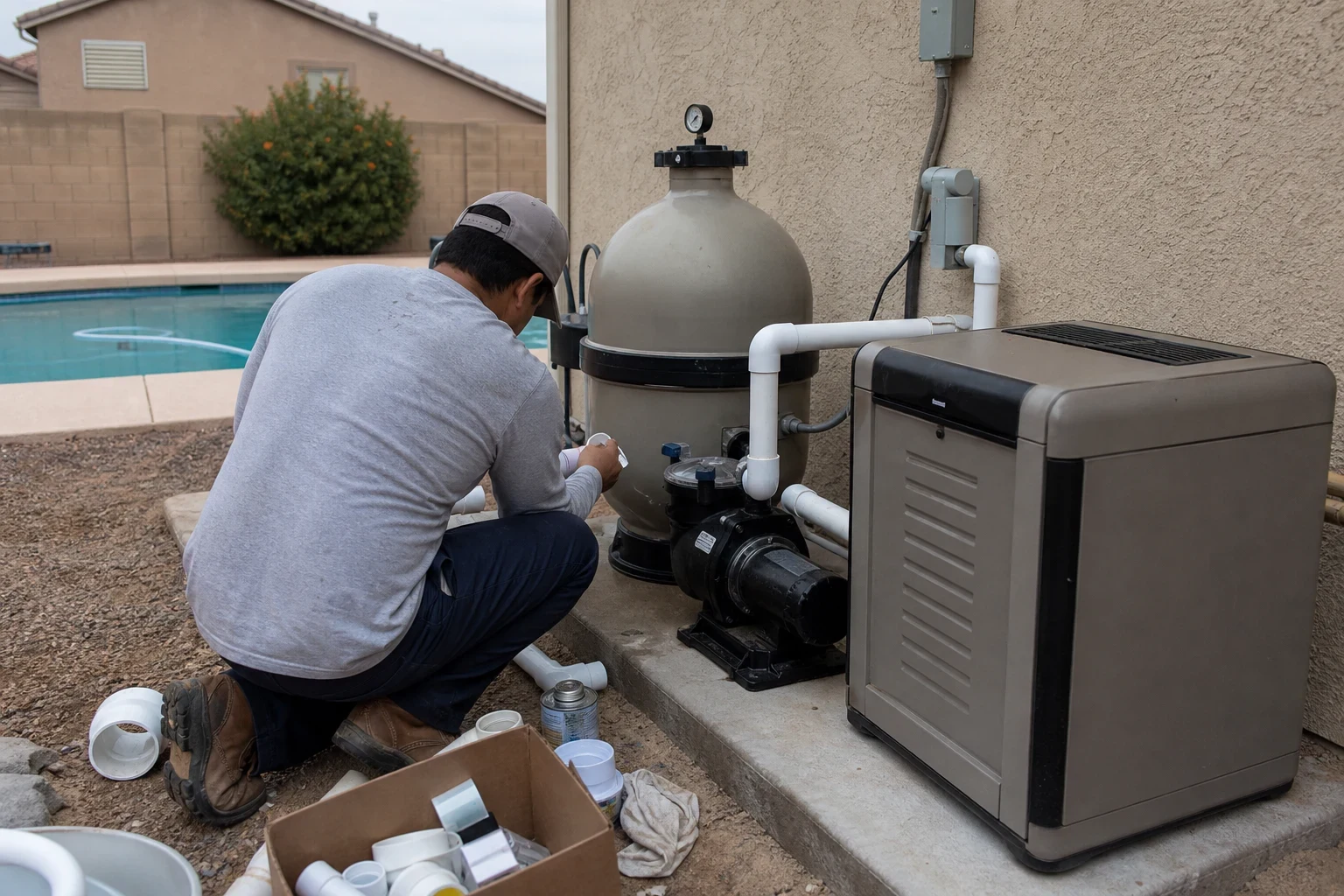
We install pumps, filters, heaters and salt chlorine generators with the details done right: glued joints that cure fully, unions at every component, a level pad and supported pipe. That is what keeps new equipment quiet, efficient and free of drips years from now.
New Equipment Only Lasts as Long as the Install
Most early equipment failures we see are not the part itself. They are a pump starved by a tight elbow right at the intake, a filter lid that weeps because the pad settled, or a joint glued without primer that lets go after a summer of heat. The equipment was fine. The installation was not.
We are CPO certified, so we size and set up each component around your pool's actual volume, turnover and plumbing. Then we take the time on the parts nobody looks at: pipe support, valve placement, bonding and a clean startup with the right settings.
If your current equipment can be saved, we will say so and point you to our pool repair service instead. Replacement is the right call when the motor, heat exchanger or tank is failing, or when an older single-speed pump is costing you more to run than a new one costs to buy.
What Our Installation Covers
- Variable-speed pumps
- Federal efficiency rules mean most replacement pumps are now variable-speed. We program the speeds for filtration, cleaner runs and any water features so the pump spends most of its day at low RPM, where it is quiet and cheap to run.
- Filters sized to the pump
- Cartridge, DE or sand, matched to the pump's flow so pressure stays in range. An undersized filter clogs fast and pushes debris through; we check the rating against your gallons.
- Heaters and heat pumps
- We set clearances, check that the pad and plumbing suit the unit and install a bypass where flow rate calls for one, so the heat exchanger is not run with too much or too little water.
- Salt chlorine generators
- We place the cell after the filter and heater, set output to your pool size and show you how to read salt levels. Hard water scales cells quickly, so we explain the cleaning schedule up front.
- Plumbing and valves
- Schedule 40 PVC, purple primer and solvent cement on every joint, unions at each component for future service, and properly sized check valves and three-way valves.
- Bonding and pad work
- We connect new equipment to the existing bonding wire and level or reset the pad so lids, unions and the pump basket seal evenly.
Signs It Is Time for New Equipment
Loud or screeching pump
Grinding or a high whine usually means motor bearings are worn. Bearings can sometimes be replaced, but on an older motor a new pump is often the better spend.
Pump trips the breaker or won't prime
Repeated tripping points to a failing motor or capacitor. A pump that will not hold prime may have a cracked housing or a worn shaft seal.
Filter pressure you can't control
If pressure climbs right after a cleaning, or a sand filter returns sand to the pool, the cartridge, grids or laterals inside may be done. A cracked tank means replacement.
Heater that cycles or won't light
Short cycling and ignition faults can come from scale in the heat exchanger or a failing control board. We test before recommending a new unit.
Power bills that jump in summer
An old single-speed pump running eight hours a day through a long Arizona summer can use far more electricity than a variable-speed pump doing the same job.
What Moves the Price of an Installation
The equipment itself is the biggest piece, but the condition of the pad and plumbing around it decides how much labor goes in. We quote the full job after seeing your setup, so the number covers the fittings and pipe work, not just the box.
Type and model
A cartridge filter, a variable-speed pump and a heat pump are very different purchases. Brand and size within each type matter too.
Plumbing changes
A direct swap with matching ports is simplest. Changing pipe size, adding a heater bypass or rerouting cramped plumbing adds fittings and time.
Pad and access
A cracked or sunken pad has to be leveled or rebuilt. Equipment in a tight side yard or behind a wall takes longer to move in and out.
Electrical and gas needs
New equipment may need a different breaker, wiring run or gas line size. We tell you during the quote if outside trades or a permit are involved.
How an Installation Day Runs
- 1
Assessment and free quote
We look at your pad, plumbing size, electrical connection and pool volume, then give you a written quote that names the exact model and every fitting and valve involved.
- 2
Removal and prep
We shut off power at the breaker, drain the lines, remove the old unit and level the pad. Old pipe that is chalky or brittle from sun exposure gets cut back to sound material.
- 3
Plumbing and connection
We dry-fit everything first, then prime and glue each joint and let it cure before pressurizing. Unions go at every component and pipe is supported so the pump is not carrying its weight.
- 4
Startup and handoff
We prime the system, bleed the air, check for leaks under pressure, program run times and walk you through the settings. Exposed PVC gets painted to slow UV damage, and we haul away the old equipment.
Equipment Installation Questions
Should I repair my pump or replace it?
If the motor is young and the problem is a seal, capacitor or impeller, repair usually makes sense. If the motor is old, noisy and single-speed, replacing it often pays back through lower power bills. We give you both numbers so you can decide.
Can you install equipment I already bought?
Yes, as long as it is the right size and type for your pool. We check the model before the install day so there are no surprises with port sizes or flow ratings.
How long does an installation take?
A pump or filter swap is usually done in a few hours. Heaters and full pad replacements take longer because of plumbing and gas or electrical work, and we schedule those with you ahead of time.
Will a variable-speed pump really save money?
In most cases, yes. Running a pump at lower speed for longer moves the same water with far less energy, and it is much quieter. We set the schedule so filtration and cleaner runs still get the flow they need.
Do I need to be home during the install?
Only for the quote and the handoff at the end, so we can show you the settings. We need access to the equipment pad and the breaker panel for the rest of the job.
Get Equipment That Is Set Up Right
Tell us what is failing or what you want to add. We will look at your pad and plumbing and give you a clear quote for the whole job.